
Camera Screen Inspector
THE CHALLENGE
The MTF Measurement
In industry, MTF (Modulation Transfer Function) is a key metric used to assess image quality (blurriness, optical distortion, etc.). When an optical system is installed in a vehicle, it typically operates behind a protective transparent screen. The resulting image quality therefore depends not only on the camera and its optics, but also on the optical properties of the protective screen and the interaction between both optical elements.
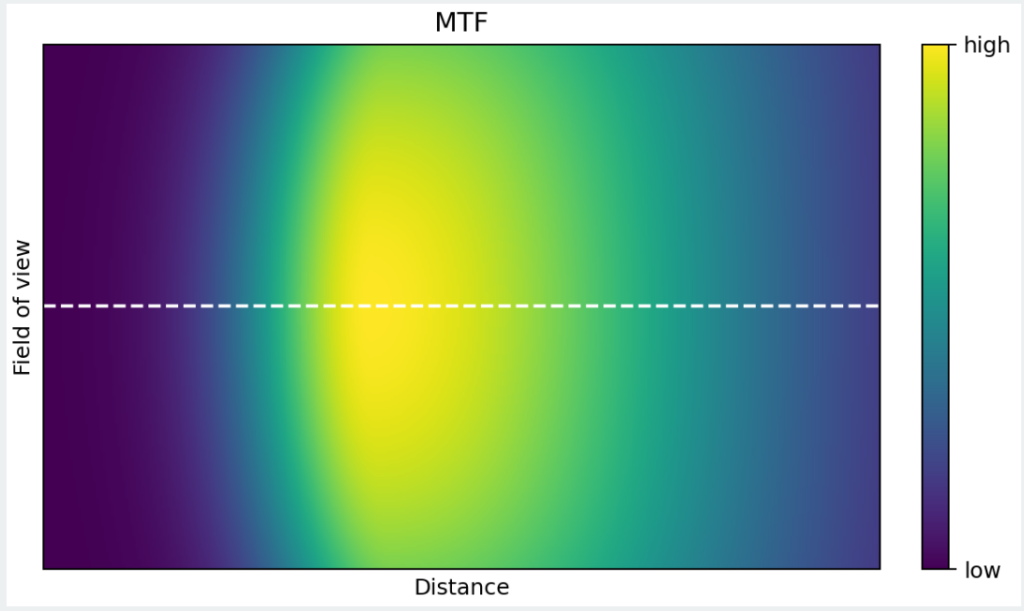
MTF is a volumetric measurement, as it depends on the position of the object relative to the camera system as well as on the focusing distance and the aperture of the optical system. It is commonly measured according to ISO 12233. However, this standard has some limitations in terms of measurement point and direction, since MTF is calculated perpendicularly to the edge, using a slanted-edge method whose orientation is fixed by the chart. To measure MTF at long focal distances in a compact way, a collimator-based system implementing the ISO 12233 is commonly used. Such a configuration also introduces additional complexity and can limit the number of available measurement points.
The Snellium technology, on the contrary, enables spatial MTF measurements over a wider field of view, at varying distances and in any direction. This approach provides a more comprehensive characterization of the optical performance and makes it possible to identify variations in image quality depending on both the position within the field of view and the target distance.
In the automotive industry
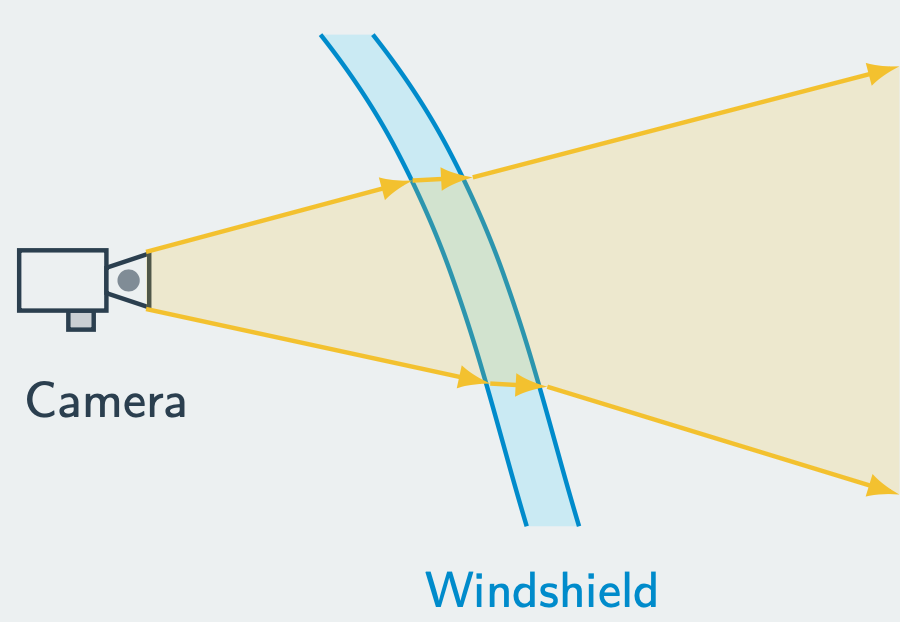
A camera system may meet its specifications on its own, but its performance can change once installed behind a windshield.
The performence of camera-based systems mounted behind the screen (ADAS camera, automotive Windshield) is affected by the screen itself, which acts as the first optical element in the system.
Small optical deviations in the screen can introduce distortion, blur or loss of resolution, potentially affecting the image available.
The challenge is therefore to characterize the performance of the entire system (camera + camera lens + screen) under operational conditions, using a compact system and including an OEM camera lens.
In the aeronautics industry
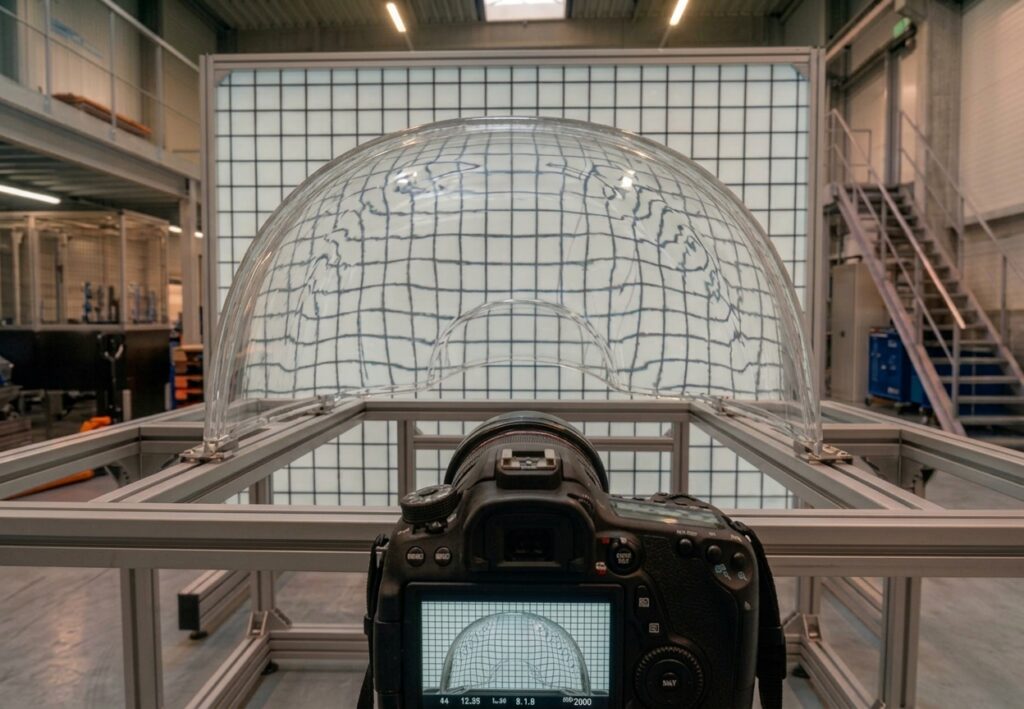
Aircraft transparencies also act as optical elements in front of cameras and optical systems.
Their geometry and optical properties can introduce distortion, blur and other optical deviations, affecting the image received by the camera.
The challenge is to provide multiple metrics to characterize the optical contribution of the transparency (optical distortion, full field MTF) and evaluate its impact on camera performance under representative operating conditions.
Camera Screen Inspector is Snellium’s solution for this application. It enables measurement and prediction of camera MTF through screens under operational conditions in a single camera shot in full camera field.
WHAT IS THE CAMERA SCREEN INSPECTOR?
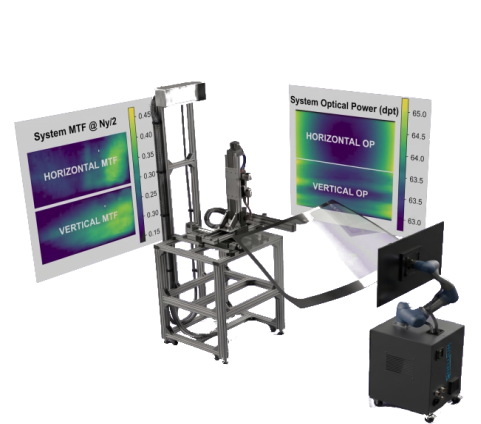
Camera screen inspector is an optical inspection and metrology solution for evaluating camera performance through windshields and protective screens.
It combines controlled optical measurements with image analysis to quantify the effects introduced by the screen.
This provides objective data that can be used during development, validation and quality control.
WHAT CAN BE EVALUATED?
Depending on the application and configuration, Camera Screen Inspector can evaluate :
Direct MTF ( Modulation Transfer Function )
Measure MTF directly through the protective screen using the actual camera optical system to assess image quality and optical performance.
Optical Distorsion / Optical Power
Characterize optical distortion and optical power introduced by the protective screen and their impact on the camera image.
MTF Prediction in operational conditions
Predict camera MTF under representative operating conditions, considering target distance and the optical effect of the protective screen.
ADAS AI training augmentation
Account for the optical effects of the protective screen to make ADAS AI training data more representative of real operating conditions.
Direct MTF (Modulation Transfer Function)
Measure MTF directly through the protective screen using the actual camera optical system to assess image quality and optical performance
Optical Distorsion / Optical Power
Characterize optical distortion and optical power introduced by the protective screen and their impact on the camera image
MTF Prediction in operational conditions
Predict camera MTF under representative operating conditions, considering target distance and the optical effect of the protective screen
ADAS AI training augmentation
Account for the optical effects of the protective screen to make ADAS AI training data more representative of real operating conditions
WHY USE THE CAMERA SCREEN INSPECTOR ?
Comprehensive Measurement
Full-field measurement of MTF and optical power across the entire measurement area using an unique Snellium technologie
Direct Measurement
Evaluate MTF directly through the OEM camera lens
Compact
A compact and integrated design that delivers complete measurement data and final results at operational conditions
Innovative
Measure MTF at any point and in any direction across the camera’s field of view, extending measurement capabilities beyond the conventional ISO 12233
Applications
Camera Screen Inspector can be used across the automotive optical quality chain: